
All articles on this site
-
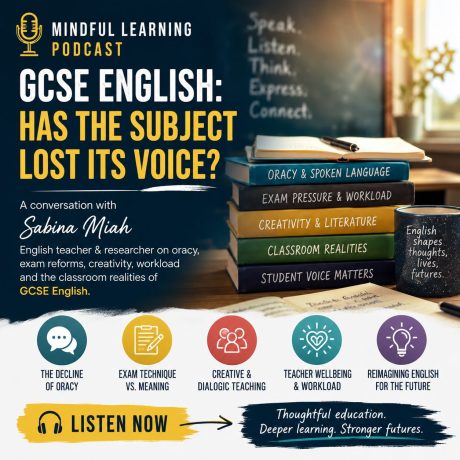
The Mindful learning podcast: Five Things You Should Know About GCSE English, Oracy and the Future of Education
In this episode of the Mindful Learning Podcast, I speak with English teacher and researcher Sabina Miah about GCSE English, oracy, creativity, workload, and what is happening inside English classrooms today. Sabina trained on the PGCE English programme at Goldsmiths and is now researching the impact of GCSE English Language reforms on teachers’ pedagogy and classroom practice. Together we explore the disappearance of coursework, the marginalisation of spoken language, the rise of “technique spotting”, silent classrooms, teacher exhaustion, and what all this means for young people. Sabina speaks candidly about the pressures facing teachers today, describing how she developed a “teacher autopilot” simply to survive the workload, while still finding meaning in “those little interactions with the students”. We discuss whether English teaching has become too formulaic, why oracy matters for democracy and social mobility, and how many classrooms have become increasingly compliance-driven. At the same time, the conversation is hopeful. We explore how English could once again become a creative, dialogic subject rooted in debate, drama, discussion, empathy, media literacy, and genuine human expression. This podcast will resonate with teachers, parents, policymakers, students, and anyone interested in the future of education. https://www.francisgilbert.co.uk/2026/05/the-mindful-learning-podcast-five-things-you-should-know-about-gcse-english-oracy-and-the-future-of-education/
-
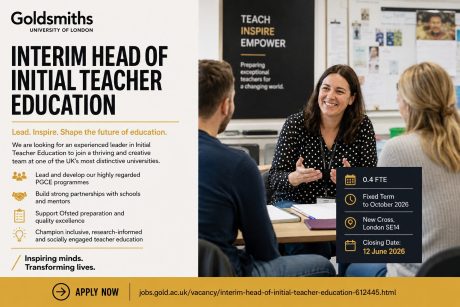
Interim Head of Initial Teacher Education Required at Goldsmiths, Join One of the UK’s Most Creative Teacher Education Communities
Goldsmiths is recruiting an Interim Head of Initial Teacher Education. This is an exciting opportunity to join one of the UK’s most creative and research-rich teacher education communities, helping lead our highly regarded PGCE programmes and shape the next generation of teachers. The advert for the role is here, https://jobs.gold.ac.uk/vacancy/interim-head-of-initial-teacher-education-612445.html
-
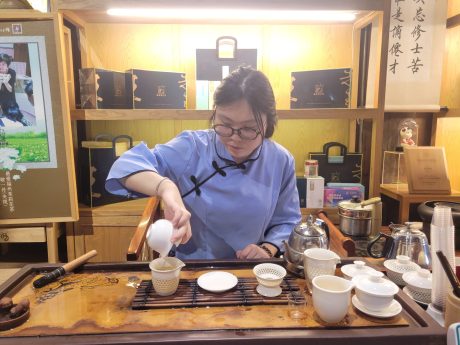
Six Things I Learnt Visiting Chinese Universities and Promoting Goldsmiths in China
Recently I spent over a week visiting universities in southeastern China, travelling through Fuzhou and Xiamen promoting Goldsmiths and exploring new educational partnerships. What I encountered challenged many of my assumptions about contemporary China. This was a country that felt simultaneously ancient and futuristic: bullet trains travelling at over 250 kilometres per hour, QR codes governing everyday life, giant digital infrastructures, but also temples filled with incense, banyan shaded parks, Confucian traditions of hospitality and colonial era streets overlooking the Taiwan Strait. I reflect on the extraordinary communal culture around food, the sheer scale of Chinese universities, the rise of China’s own postgraduate sector, and the way figures such as Mao, Deng Xiaoping, Nixon and Kissinger still haunt the political and historical imagination in very different ways from the West. I also explore how China’s technological self sufficiency, from WeChat to digital payments, creates a society that is both incredibly efficient and deeply distinctive from Europe or America. Along the way, I found myself thinking about great travel writers such as Colin Thubron and Peter Hessler, and how travel changes not just our understanding of another country, but of our own.
-

Seven Things Inter Alia Taught Me About Middle Class Guilt, Work and Family Life
This blog explores why Suzie Miller’s Inter Alia feels like such an important play for our moment. Ostensibly a legal drama about a judge whose son is accused of rape, the play becomes a powerful meditation on middle class family life, emotional labour, modern masculinity and the hidden pressures faced by professional women. Drawing on Rosamund Pike’s extraordinary performance as Judge Jessica Parks, the blog reflects on the contradictions at the heart of contemporary liberal family life. Jessica is professionally authoritative, intellectually formidable and morally serious, yet privately overwhelmed by the demands of motherhood, marriage and emotional responsibility. The blog examines how the play exposes the unequal burdens still placed upon women, even within supposedly progressive households. It also considers the play’s exploration of boys, pornography, internet culture and the rise of the manosphere, asking how young men are shaped by online misogyny when fathers remain emotionally distant and mothers are stretched to breaking point. The gradual disintegration of the family home on stage becomes a metaphor for the emotional fragility beneath polished middle class success. Combining personal reflection, cultural criticism and close attention to the production’s staging and themes, the blog argues that Inter Alia is not simply about rape culture or the legal system. It is about exhaustion, guilt, intimacy and the emotional cost of trying to “have it all” in contemporary Britain. The piece will particularly resonate with parents, teachers, therapists, academics and anyone interested in feminism, theatre and modern relationships.
-
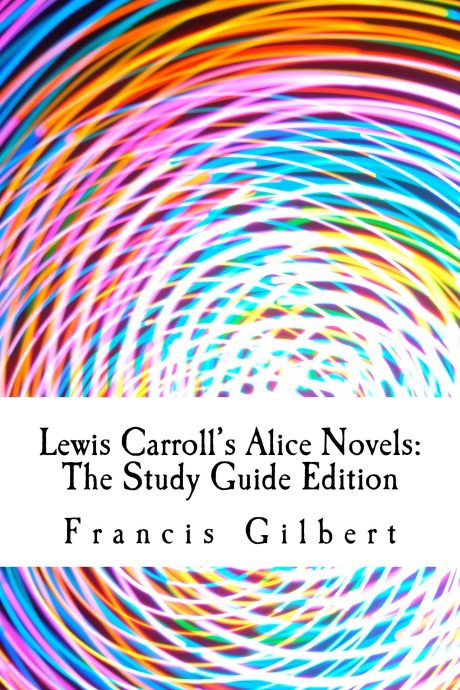
Lewis Carroll’s Alice Novels: The Study Guide Edition
Step into Wonderland with a fresh, interactive approach to Lewis Carroll’s classic novels. Lewis Carroll’s Alice Novels: The Study Guide Edition combines the complete texts of Alice’s Adventures in Wonderland and Through the Looking-Glass with commentary, creative activities, teaching ideas and discussion questions designed to deepen readers’ understanding and enjoyment. Rather than simply summarising the stories, the book explores themes such as identity, dreams, nonsense, childhood, power and imagination, encouraging readers to think critically and creatively about Carroll’s strange and enduring worlds. Ideal for students, teachers, trainee teachers and lovers of children’s literature.
-
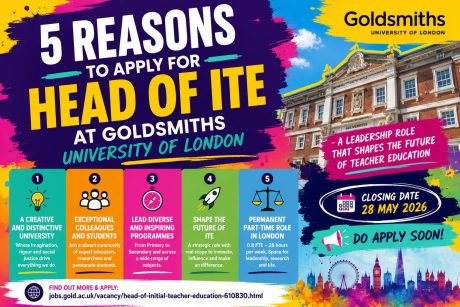
Five Reasons to Apply for Head of Initial Teacher Education at Goldsmiths
Goldsmiths, University of London is currently advertising for a new Head of Initial Teacher Education, and I genuinely believe it is one of the most exciting leadership opportunities in teacher education at the moment. https://jobs.gold.ac.uk/vacancy/head-of-initial-teacher-education-610830.html Goldsmiths has played a major role in educating the nation’s teachers since the early 1900s and has built a longstanding reputation for excellence, creativity and innovation in teacher education. Our PGCE programmes are distinctive because they combine rigorous academic study with reflective, inclusive and imaginative approaches to teaching and learning. In this blog, I outline five reasons why this role offers such a special opportunity. These include the chance to work within a university known internationally for creativity and critical thinking; to lead a rich portfolio of Primary and Secondary PGCE programmes; to collaborate with outstanding colleagues and highly motivated students; to shape the future direction of Initial Teacher Education during a period of national change; and to do so within a permanent part-time role that allows space for research, writing and wider professional practice. Goldsmiths offers PGCE programmes across subjects including English, Drama, Mathematics, Media, Science, Art and Design, Modern Languages and Primary Education, all underpinned by a strong commitment to social justice, creativity and educational excellence. The closing date is 28th May 2026, so do apply soon if you are interested in joining a vibrant and forward-looking educational community.
-
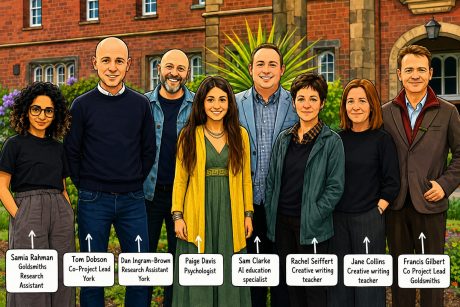
Seven Things I Learned from the Creative Writing Together Kickoff Meeting at York St John University
Really excited to share my latest blog about the launch of the AHRC-funded Creative Writing Together project at York St John University. Last week, in early May 2026, our brilliant interdisciplinary team gathered for the first major kickoff meeting, bringing together creative writers, educators, psychologists, researchers and digital innovators to explore how creative writing can support reflective functioning, empathy, wellbeing and social change. In the blog, I reflect on seven key things I learned from our first week together, including why creative writing projects are built through relationships, how writing from another perspective can transform empathy, the continuing power of free writing, why ethical AI needs principles rather than panic, and how strong structures make creative freedom possible. It was genuinely inspiring to work alongside colleagues including Tom Dobson, Samia Rahman, Dan Ingram-Brown, Paige Davis, Sam Clarke, Jane Collins, Rachel Seiffert and many others as we begin what feels like a deeply important and hopeful project. Creative writing is not ornamental. It helps people connect, reflect and imagine differently. Read the full blog here: https://www.francisgilbert.co.uk/2026/05/seven-things-i-learned-from-the-creative-writing-together-kickoff-meeting-at-york-st-john-university/ If you’re reading this on Instagram, please paste the link into your browser to access the full article.
-
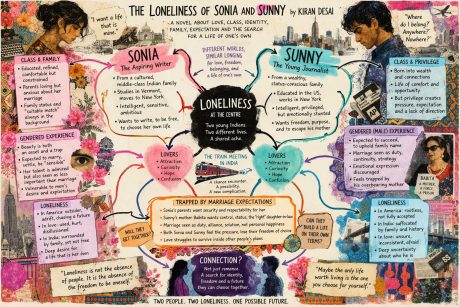
Seven things I learnt from reading The Loneliness of Sonia and Sunny
I’ve just finished reading The Loneliness of Sonia and Sunny by Kiran Desai, and it’s stayed with me in a way very few novels do. What begins almost like a Jane Austen comedy of manners, a letter between families trying to arrange a match, becomes something far more expansive and unsettling. This is a novel about love, yes, but also about class, migration, identity, and the strange loneliness of living between worlds. Sunny, trapped between Indian privilege and American aspiration, is brilliantly drawn. Sonia, a gifted writer hemmed in by expectation, is just as compelling. But what really surprised me was Babita, Sunny’s monstrous, snobbish, controlling mother, who somehow becomes one of the most sympathetic figures in the book. Desai achieves something remarkable there. The novel moves across Delhi, Goa, New York and beyond, but never feels showy. It feels lived. There is humour, darkness, exploitation, tenderness, and a real sense of how people get trapped in the lives they inherit. For all its sophistication, it’s also deeply readable. There’s a real “will they, won’t they” energy running through it, even as it tackles much bigger questions. One of the most accomplished novels I’ve read in years.
-

Five Things I Learnt from Tobias Hill’s Writing
I met Tobias Hill in 1999, in a London literary world that felt alive, exploratory, not yet fully digitised. Very different from now in 2026. We stood outside a sealed Underground entrance in Kentish Town, a space that had quietly taken on another life, hidden, ambiguous, charged. Tobias was drawn to it, not for spectacle, but because he was always interested in what lay beneath. That sense of him has stayed with me. In this blog, I reflect on five things his writing taught me, about mystery, the underground, humanity, metaphor, and the unconscious. Hill’s work moves through cities, objects, and histories with extraordinary precision, always searching for meaning within the specific. I’ve also included a digitally generated image of Tobias, a symbolic portrait rather than a literal one. I suspect, slightly ironically, that the Tobias I knew would have found it amusing. He wasn’t po-faced about art or writing, quite the opposite, he was playful, curious, alive to odd juxtapositions. I think he would have laughed, at least a bit. I offer it in that same spirit of playfulness he brought to his work, while also trying to gesture towards something else he captured so well, the uncanny sense that the familiar world is always on the edge of becoming strange. For me, the image became a way of thinking about Tobias as a kind of time traveller, still moving through the underground spaces he wrote about, still connecting with us through his work. He touched many lives, and continues to do so. I really miss him, even though I did not know him that well; I miss his literary presence in particular. This piece is an attempt to honour his humanity and work. Read the full blog here: https://www.francisgilbert.co.uk/2026/04/five-things-i-learnt-from-tobias-hills-writing/
-
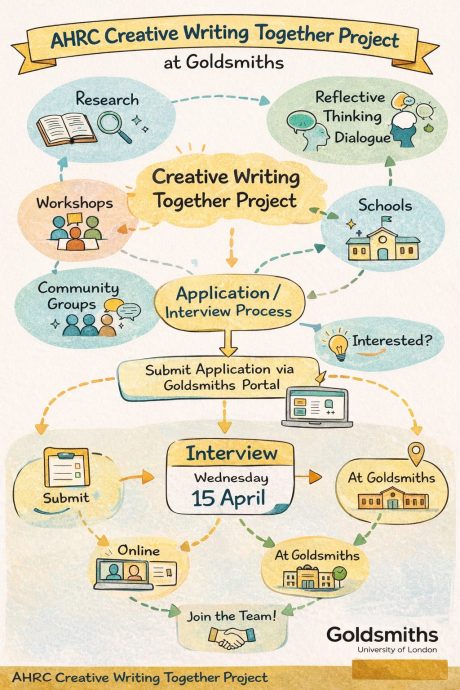
Two New Roles on the AHRC Creative Writing Together Project at Goldsmiths
I’m delighted to be recruiting for two roles on our AHRC funded Creative Writing Together project at Goldsmiths, University of London. The project explores how creative writing can support reflection, wellbeing, and dialogue across generations, working with schools, community groups, and writers across London. We are looking for a Research Assistant (.5 FTE) and a Short Courses and Training Officer (.2 FTE) to join the team from 1 May 2026 to 30 April 2029. Full details, including the job descriptions, are now available on my blog. If you are interested, please send a formal letter of application and CV to me, Dr Francis Gilbert at f.gilbert@gold.ac.uk by Thursday 25 March at 4pm. Interviews will take place 31 March, either online or in person at Goldsmiths, and please state your availability for interview in your application. A formal advert will appear on the Goldsmiths website shortly, but I am sharing details early in case colleagues, doctoral researchers, teachers, writers, or community practitioners may be interested. Do take a look at the blog post and feel free to share it with anyone who might be a good fit.
-
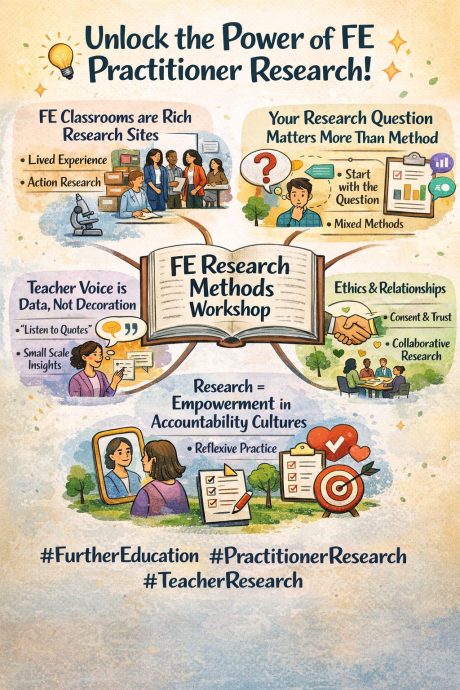
Five Things FE Teachers Can Learn from Small Scale Research
As part of the British Library’s Learning Skills Research Network, Debbie Bogard and I co-led an online Learning and Skills Research Network session exploring research methods and data collection in Further Education. At first I joked that research methods might not be the most thrilling topic. Yet the discussion quickly showed the opposite. When research begins with real classrooms, real teachers, and real learners, it becomes deeply engaging. The session centred on a simple but powerful idea. Small scale practitioner research can generate profound insight. FE classrooms are rich research sites where teachers already observe patterns, dilemmas, and possibilities every day. Research is not something distant or purely academic. It begins with curiosity about practice. Five themes emerged strongly. First, FE classrooms contain valuable knowledge worth studying. Second, the research question matters more than the method. Third, teacher voice is not decoration but a form of data that reveals how systems actually operate. Fourth, ethics sit at the centre of practitioner research because education is fundamentally relational. Finally, research can be empowering. In systems shaped by accountability pressures, inquiry allows teachers to step back, reflect, and understand their work more deeply. The workshop reminded us that practitioner research is not about grand projects. It is about paying attention to practice and learning from it together.
-
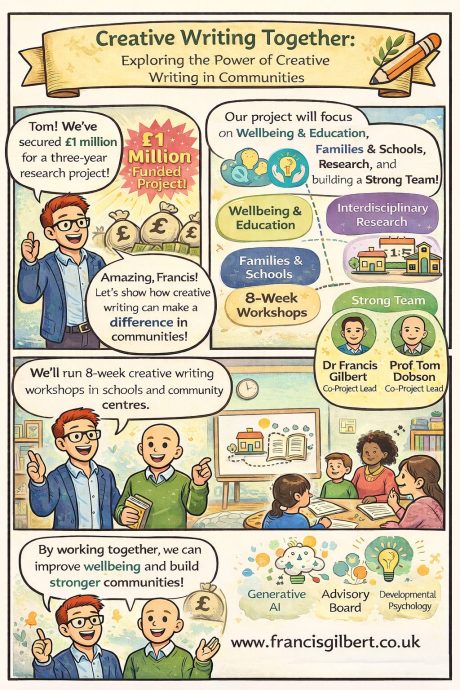
Why Creative Writing Together Matters, A £1m Research Project for Families, Schools and Communities
I am delighted to share that Professor Tom Dobson and I, working with an exceptional interdisciplinary team, have secured close to £1 million in funding for a three year research project, Creative Writing Together. This major award supports an ambitious investigation into how creative writing can strengthen relationships between children, parents, teachers and communities, and enhance wellbeing across educational settings. At a time when schools and families are facing rising mental health challenges, increasing absence and deepening inequalities, we are asking a simple but powerful question. What if creative writing were treated not as an optional enrichment activity, but as a relational practice that helps people understand themselves and one another more deeply? The project centres on the concept of reflective functioning, the capacity to make sense of behaviour in terms of thoughts, feelings and intentions. Strong reflective functioning is associated with secure attachment, improved relationships and emotional regulation. Yet creative writing has rarely been studied as a preventative, community based approach to developing these capacities. Over three years, we will run eight week programmes in schools and community centres in London and York, bringing families and teachers together to write collaboratively. Combining action research, psychological measures and close analysis of participants’ writing, we aim to generate robust evidence and practical resources that can inform policy and practice. Creative Writing Together positions writing as a shared, transformative act. In a fragmented educational landscape, it offers a hopeful vision of creativity as connection.
-
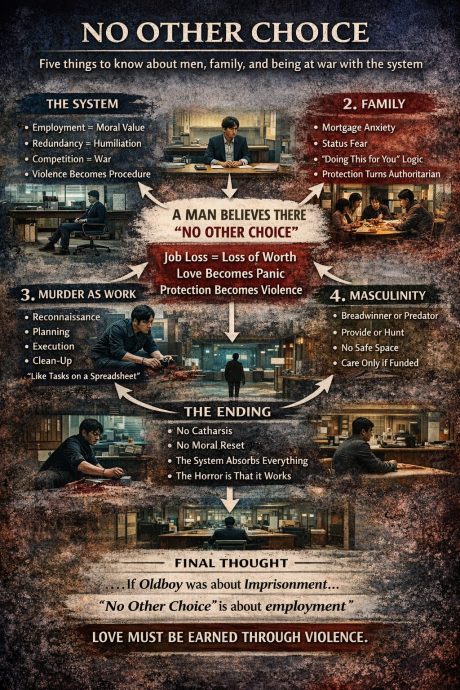
No Other Choice, five things we can learn about men, family, and being at war with the system
I recently watched Park Chan-wook’s No Other Choice, and I cannot stop thinking about it. It is a film that makes you laugh, then makes you question the laughter. In a cinema full of people, there were audible laughs during scenes of murder, not because they were comic in any simple way, but because they were staged with such grim, bureaucratic practicality. The premise is brutally simple. A laid-off paper expert decides to kill his rivals for a job so he can protect his family. What unfolds is not just a thriller, but a devastating portrait of masculinity under neoliberal pressure. When a man’s worth is fused with his wage, unemployment feels like erasure. Love becomes panic. Protection becomes predation. What shocked me most was not the violence, but how easily the system absorbs it. The film suggests that modern corporate life already trains us to think in terms of targets, elimination, competition, survival. If Oldboy was about imprisonment as destiny, No Other Choice is about employment as destiny. It is disturbing, funny, precise, and deeply humane. A film about men, family, and what happens when the system leaves you believing there is no other choice.
-
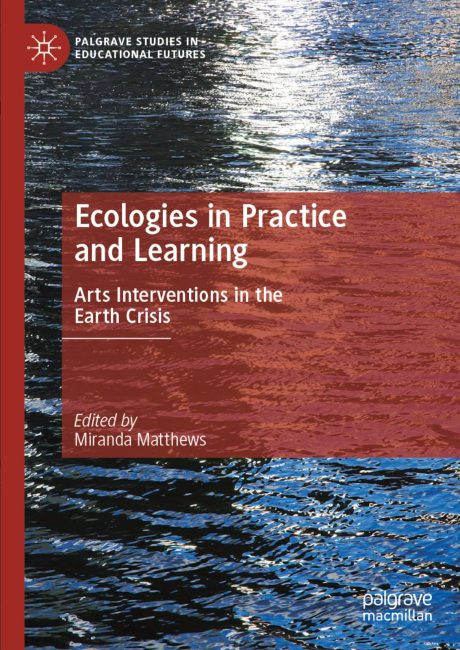
Ecologies of Practice and Learning (Book chapter)
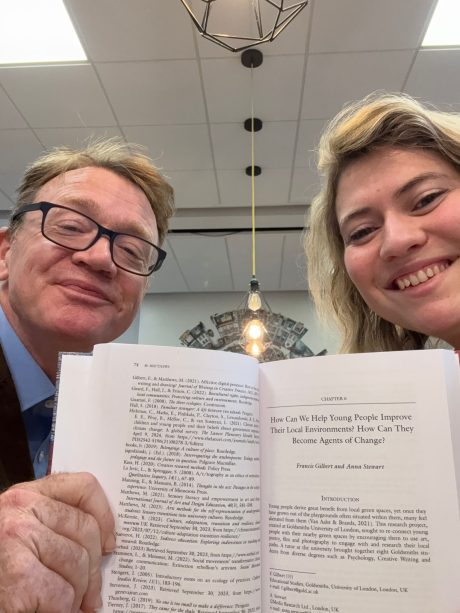
How can creative research help young people become agents of environmental change? This post highlights a chapter I co-authored with Anna Stewart in the edited collection Ecologies in Practice and Learning: Arts Interventions in the Earth Crisis. The book brings together arts educators, researchers and practitioners exploring how learning, creativity and ecological action intersect in a time of environmental crisis. Our chapter draws on the Parklife project, where young people aged eleven to fourteen became co-researchers into a local park. Using poetry, art, film, photography and surveys, they explored safety, ecology and belonging, and presented their findings directly to decision-makers. The result was real change on the ground. The chapter argues for creative, participatory research as a powerful tool for environmental education and democratic engagement, and for parks as classrooms without walls. You can read and download the full article via my website.
-
Five reasons to get young people researching their local parks
What happens when we stop seeing young people as a problem in parks, and instead invite them to become researchers, artists and agents of change? This blog, and the chapter it draws on, grows out of the Parklife project, a collaboration between university students, school pupils and local communities. It sets out five reasons why supporting young people to research their local parks matters now. Using creative and participatory methods such as poetry, visual art, film and surveys, the project showed what becomes possible when young people’s insights are taken seriously. Pupils aged eleven to fourteen became co-researchers rather than passive participants. They explored questions of safety, ecology, care and belonging, and presented their findings directly to councillors and park managers. The outcome was tangible change, including improved lighting, better litter management and new community facilities. The research also speaks to wider debates about education, environment and democracy. It challenges deficit narratives about youth, demonstrates the policy impact of creative research, and reimagines parks as classrooms without walls. The article is available open access via the Goldsmiths research repository and is published as a chapter in Ecologies in Practice and Learning: Arts Interventions in the Earth Crisis, situating Parklife within international conversations about socially engaged research and environmental futures. You can read the full copyright-free article here: https://www.francisgilbert.co.uk/2026/02/five-reasons-to-get-young-people-researching-their-local-parks/ Springer book: https://link.springer.com/book/10.1007/978-3-031-82338-1 Goldsmiths repository: https://research.gold.ac.uk/id/eprint/40154/
-
Six ways to engage local communities through creative writing at St Mary’s Church, Walthamstow
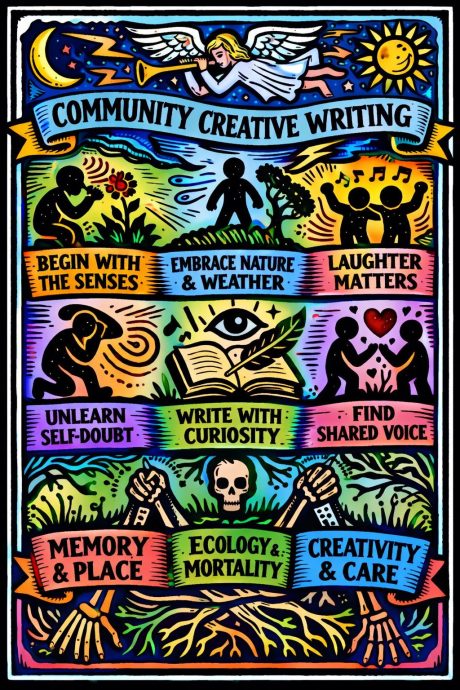
St Mary’s Churchyard in Walthamstow is more than a restored historic site. It is a living commons, a place where gardening, conversation, memory, and creativity quietly intertwine. On a January afternoon, we gathered there with students from the MA Creative Writing and Education at Goldsmiths for a community writing session that showed just how powerful local, place-based creative work can be. Led by two MA students, Sophie and Priyanka, the session moved fluidly between sensory attention and playful experimentation. Smell, wind, weather, laughter, discomfort, poetry, and the natural world all became entry points into writing that felt inclusive, serious, and alive. Volunteers and students wrote side by side, discovering that creative confidence grows not through expertise but through permission, attention, and shared experience. What emerged was a practical, replicable model for community creative writing. One that does not demand performance, prizes curiosity over polish, and allows ecological awareness to arise through voice rather than instruction. This post reflects on six key practices from the session, offering ideas for anyone interested in engaging local communities through creative writing, mindfulness, and place.
-
Five Ways to Teach Creative Writing to Teenagers
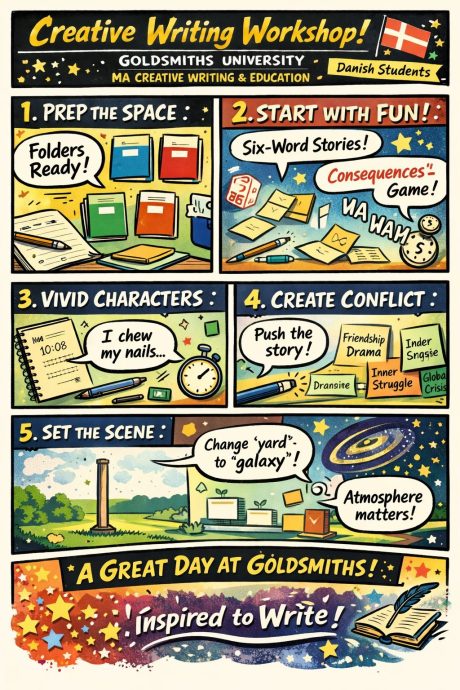
Forgive the comic strip. It is there simply to convey the energy, playfulness and creative momentum of what was a genuinely joyful afternoon of creative writing at Goldsmiths. Recently we welcomed a brilliant group of Danish teenagers to campus for a creative writing workshop, led by their teacher Margit from DATE and NATE. They arrived full of curiosity, quickly made the space their own, and threw themselves into the session with enthusiasm, laughter and serious thought in equal measure. The workshop was led by three MA Creative Writing and Education students, Niki, Elizabeth and Priyanka, who guided the group through a series of carefully structured but low-stakes activities. From six-word stories and the joyful chaos of Consequences, to thinking about character through one vivid detail, conflict as the engine of story, and setting as atmosphere rather than description, the session offered a clear reminder of what works when teaching creative writing to teenagers. The comic strip gestures towards these ideas in a playful way, but what it really points to is something deeper. Teenagers being welcomed into a university. Future teachers developing their craft. And young writers discovering that language is something to explore and enjoy rather than fear. A brilliant snapshot of the MA Creative Writing and Education in action.
-
To Be Hamnet or Hamlet; that is the question — Seven lessons I learnt from watching Hamnet
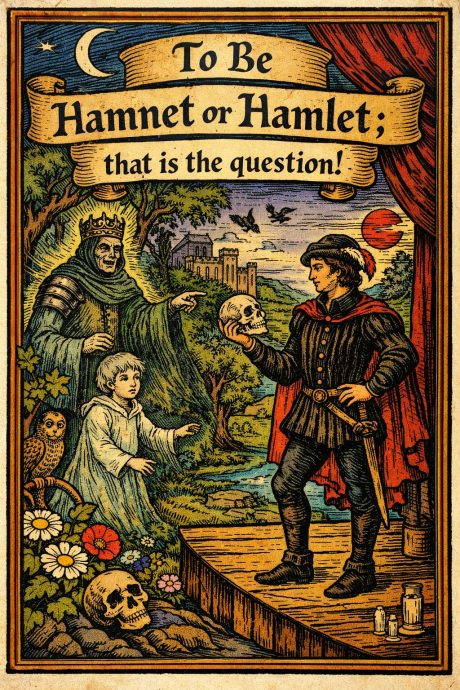
To Be Hamnet or Hamlet; that is the question Seven lessons I learnt from watching Hamnet NB: This review contains spoilers. What if Hamlet is not just a tragedy about revenge, but an unfinished conversation with grief? I watched Hamnet at my local cinema, Crouch End Picturehouse, and came away unsettled, moved, and intellectually provoked. I taught Hamlet for A level English for years and thought I knew the play inside out. This film quietly dismantled that confidence, not by claiming new facts, but by offering a bold emotional reading and asking the viewer to live inside it. The premise is historically sound. Shakespeare’s son Hamnet died aged eleven in 1596; Hamlet was written several years later. What the film explores is what can never be proven, how grief might echo, displace itself, and reappear through art. From Anne Hathaway’s embodied mourning, to forests that seem to think alongside human loss, to the suggestion that Hamlet functions as a kind of family therapy, this is a film that invites big questions. I ended up getting seriously drawn in, researching grief theory, psychoanalysis, family systems, authorship, and early modern ideas of selfhood. Freud sits alongside contemporary bereavement research; Shakespeare studies meet post Covid loss. You will not read a better informed blog on this film. This is a flawed, troubling, and genuinely thought provoking piece of cinema. Shakespeare specialists may wince; others may cry; some people walked out. I recommend it with curiosity rather than reverence. If you’re interested in how stories allow us to enter difficult emotional spaces without explaining them away, this one is for you. If you’re reading this on Instagram, please paste the link into your browser to access the full article.
-

Free Human Givens Therapy Sessions, A Practical and Supervised Offer
I’m currently offering a small number of free Human Givens therapy sessions as part of the final stage of my professional training. This is a practical, solution focused approach that does not require you to talk about childhood trauma unless you want to. The work is often closer to coaching and focuses on challenges you are dealing with now, such as anxiety about work or money, relationships, confidence, or feeling stuck or overwhelmed. All sessions are confidential, ethical, time limited, and fully supervised by an accredited and registered Human Givens therapist. You can read more about my background, training, and approach, including an FAQ, here: https://www.francisgilbert.co.uk/therapy/ If you are interested, please email me at sir@francisgilbert.co.uk . I will reply personally and in confidence.
-

Six Things I Learnt About Home Making from the Film Sentimental Value
Six things we can learn about home making from Sentimental Value What if home is not a place at all, but something we make moment by moment with other people? In Joachim Trier’s Sentimental Value, a Norwegian house becomes a vessel for memory, trauma, silence, and art. The film asks difficult questions about listening, inheritance, history, and how families survive when love is expressed imperfectly or too late. This piece reflects on six lessons about home making drawn from the film, from the way houses remember what people try to forget, to why care cannot be reduced to attentiveness alone, and how home may ultimately be created through reciprocal understanding rather than walls or ownership. The concept map above distils these ideas visually. Read the full blog here: www.francisgilbert.co.uk If you’re reading this on Instagram, please paste the link into your browser to access the full article.
topics I’ve written about on this site
- Archived (444)
- Creative Writers (17)
- Creative Writing Together AHRC Grant (3)
- FGI Publishing (35)
- Dr Jekyll & Mr Hyde: A dramatic adaptation of Stevenson's classic novel (2)
- Dr Jekyll & Mr Hyde: The Study Guide Edition (4)
- Far From The Madding Crowd: A Study Guide (2)
- Frankenstein: A Study Guide (2)
- How to Get a Great English Degree (2)
- Jane Eyre: A Study Guide (2)
- Learning Matters (2)
- Pride and Prejudice: A Study Guide (2)
- Songs of Innocence and Experience: A Study Guide (2)
- St. Cupid's (1)
- Star-crossed: Romeo and Juliet for Teenagers (2)
- The Hound of the Baskervilles: A Study Guide (2)
- The Long Game (6)
- The Mindful Creative Writing Teacher (2)
- The Mindful English Teacher (1)
- The Strange Case of Dr Jekyll and Mr Hyde: A Study Guide (2)
- The Turn of the Screw: A Study Guide (2)
- Wuthering Heights: A Study Guide (2)
- For (193)
- for academics (57)
- for parents (33)
- for students (97)
- for teachers (87)
- Therapists (13)
- Key concept (234)
- Academies (13)
- Admissions (5)
- Aesthetic autobiography (5)
- Analysing autobiography (4)
- Analysing quotation (5)
- Autobiographical classroom materials (4)
- Bullying (4)
- Child Language Acquisition (17)
- Choosing A Secondary School (3)
- Collective Identity (4)
- Communication (10)
- Comparison (5)
- Creative writing and therapy (8)
- Creative Writing Teaching (29)
- Curriculum change (8)
- Digital learning (6)
- Discipline (27)
- Education reform (59)
- English Baccalaureate (4)
- Free Schools (6)
- International comparisons of schools (2)
- Language Development (5)
- Media Studies (6)
- Mindfulness (8)
- Model answers (3)
- Ofsted (4)
- Punishments (4)
- Reading Reform (11)
- Resources (3)
- Reviews (13)
- School entrance (5)
- Semantic change (2)
- Specialist teachers (4)
- Student Voice (2)
- Teacher training (18)
- Teaching Unions (4)
- The Publishing Industry (13)
- Travel (1)
- Yob culture (12)
- Media appearances (35)
- BBC 2 Newsnight (2)
- BBC Breakfast (5)
- BBC News (2)
- BBC Radio3 (6)
- BBC Radio4 (5)
- BBC Radio5 Live (10)
- Channel 4 News (1)
- Channel 5 News (3)
- GMTV (2)
- ITV News (1)
- Sky News (1)
- Mindful Learning Podcast (10)
- My books (39)
- Anthologies (4)
- Fiction (4)
- Non-fiction (10)
- Study guides (18)
- Opinion (247)
- Book reviews (2)
- Drama reviews (2)
- Film and TV reviews (1)
- Published in (239)
- Academic articles (31)
- Blue Door Press (6)
- English Online (2)
- Local Schools Network (35)
- Long Game Articles (6)
- Mumsnet: talesbehindtheclasroomdoor (3)
- NAWE Magazine (2)
- Newsweek (1)
- Politico.eu (1)
- Reviews (1)
- Teachit.co.uk (1)
- The Big Issue (2)
- The Daily Mail and Mail on Sunday (8)
- The Daily Telegraph (24)
- The Evening Standard (3)
- The Guardian (43)
- Comment Is Free (29)
- The Local Schools Network (9)
- The New Day (1)
- The New Statesman (7)
- The Observer (4)
- The Tablet (1)
- The Times and The Sunday Times (33)
- The Times Educational Supplement (10)
- The Western Daily Press (6)
- The Yorkshire Post (4)
- Titles (31)
- UK education system (90)